
The Eye of Horus: Its Meaning and the Myth Behind It
It is one of the most recognisable symbols in the world: a single eye, outlined in dark paint, with a line sweeping back from its corner, and beneath it a teardrop and a long curling tail. You will find it on ancient coffins and royal jewellery, in the hieroglyphs on temple walls, on tattoos and necklaces, and today on the walls of souvenir shops all over Egypt. It is the Eye of Horus, and behind it is the story of a stolen throne and an eye that was broken and healed.
The myth: a battle for the throne
In the beginning of the story, the god Osiris rules Egypt as a wise and good king. His brother Set, god of the desert, storms and chaos, is consumed by jealousy. Set murders Osiris and takes his throne.
Osiris’s wife, the goddess Isis, searches the land for her husband’s body. With her magic she brings him back to life long enough to conceive a son, Horus, whom she hides and raises in secret in the marshes of the Nile Delta. When Horus grows up, he sets out to avenge his father and claim the throne that is rightfully his.
The struggle between Horus and Set is long and brutal. In one of their battles, Set tears out Horus’s eye and breaks it into pieces. But the eye is found and made whole again. In most versions of the myth it is Thoth, the wise god of writing and magic, who restores it; in another, the goddess Hathor heals it with gazelle’s milk.
Horus does not keep the healed eye. He offers it to his dead father, Osiris, and through this gift Osiris is revived to rule over the afterlife. Horus wins the throne of the living and becomes the protector of the kings of Egypt, every one of whom was seen as Horus on earth.

What the Eye of Horus means
The Egyptians called it the wedjat, which means “the sound one” or “the whole one”. It is the eye that was broken and made whole again, and so it stands for everything that the myth tells: protection, healing, restoration and the triumph of order over chaos.
Horus was a falcon god, and the eye is a falcon’s eye as much as a human one. Look at the face of a peregrine falcon and you will see the same dark marking sweeping down beneath its eye, the origin of the teardrop and tail of the symbol.
The Eye of Horus and the Eye of Ra
The two are often confused, and the ancient Egyptians themselves sometimes blurred them. As a general rule, the Eye of Ra is linked to the Sun and to the fierce power of the Sun god, often shown as a goddess who can protect or destroy. The Eye of Horus is linked to the Moon, which wanes and is made whole again each month, just as the eye was broken and healed. You will often read that the Eye of Ra is the right eye and the Eye of Horus is the left, a useful way to remember the difference.
The mathematical eye
You may also read that each part of the eye stood for a fraction (one half, one quarter, one eighth, and so on down to one sixty-fourth), and that the missing sixty-fourth was the piece Thoth restored by magic. It is a popular idea, though many Egyptologists today doubt the connection.
The most popular amulet in Egypt
For thousands of years, Egyptians wore the wedjat to keep harm away. It was made in faience, glass, gold, silver, carnelian and lapis lazuli, worn on necklaces and bracelets by the living, and placed among the wrappings of the dead to protect them on their journey to the afterlife. It is one of the most common amulets found in ancient Egyptian tombs.
Tutankhamun was buried with jewellery bearing the wedjat, and you can see some of it among his treasures in the Grand Egyptian Museum. On many coffins of the Middle Kingdom, a pair of eyes was painted on the side of the coffin, where the face of the dead lay, so that they could look out at the world of the living and the rising Sun.
The eye also appears in hieroglyphs, on temple walls and on stelae, and painters and sailors are said to have painted eyes on the prows of boats so that they could see their way and avoid danger, a custom you can still find on fishing boats around the Mediterranean.

The eye in Egypt today
The ancient gods are long gone, but the eye never left Egypt. It lives on in a different form in the blue glass eye beads sold in every market, pinned to babies’ clothes, hung in cars and over shop doors to turn away envy. It stares out from the backs of the painted trucks on Egypt’s highways, as we explain in our story of Egyptian truck art. And it is still worn, as a pendant or a tattoo, by people all over the world who want to carry a little protection with them.
The belief behind it has hardly changed in five thousand years: that a watchful eye, painted with care, can turn away harm and bring what is broken back to wholeness.
Wearing the eye
We painted our own Eye of Horus in bold blue, orange and yellow, beneath a corner of starry night sky, and printed it on the back of a white oversized T-shirt. It is part of The Season of the River, our summer collection of Egypt’s oldest stories, alongside Ra’s night journey in hieroglyphs, the golden women of an ancient wall painting, and a cat keeping watch over Cairo.
See the Eye of Horus T-shirt and the rest of our Egyptian art apparel. And if you are travelling to Egypt to meet the eye in its homeland, our Cairo Guide will help you plan the trip.
Egyptian Truck Art: Why Cairo’s Trucks Are Covered in Eyes and Stars
Drive the desert road from Cairo to Alexandria, and sooner or later you will find yourself behind a terella. The word comes from “trailer”, and it means the great trucks that carry Egypt’s goods along its highways: huge, wobbly, often loaded far higher than seems possible, with a container or two swaying on the back.
Look closer, though, and you will see that its back and sides are painted like a canvas. Eyes stare out at you. Stars, crescents and stripes in red, yellow and green run along the edges. Horses gallop, pigeons fly, flowers bloom, and somewhere among them, in bold Arabic letters, a phrase makes you smile. Egypt’s roads are lined with one of its liveliest galleries of folk art, and it moves at eighty kilometres an hour.
Why paint a truck?
Part of the answer is practical. The designs are painted in bright, reflective and glowing colours that catch the headlights at night, and on dark desert roads that keeps the truck, and its driver, visible and safe.
There is also a much older reason. The art is meant to overwhelm you. So many colours, patterns and images compete for your attention that your gaze cannot settle on the truck itself, and so it cannot carry envy. In Egypt this envious gaze is called hasad, or the evil eye, and the belief that a jealous look can bring bad luck to whatever it falls on is thousands of years old. A truck is a driver’s livelihood, often his family’s whole fortune. Its decoration works as an amulet, a shield of colour against harm.

Reading a terella
Each truck is different, but the same symbols return again and again, and each one has a meaning.
- The eye. The most important of all. A painted eye watches back at the watcher, turning the evil eye away. It is the direct descendant of a protective sign Egyptians have worn for thousands of years, from the ancient Eye of Horus to the blue glass beads still sold in every market.
- The hand. An open hand with five fingers, often blue, is another ancient shield. In Egypt, the number five itself is said to ward off envy, and you may hear someone say “khamsa wa khmeesa”, five and little five, when they want to protect something they love.
- Stars and crescents. Symbols of faith and of the night sky, and an echo of the decoration of mosques and homes.
- Horses. Strength, speed and endurance: everything a driver wishes for his truck.
- Pigeons and birds. Peace, home and freedom. Cairo’s rooftops are full of pigeon towers, and the birds fly across the trucks too.
- Stripes and borders. Bright bands of colour that frame everything, and catch the light at night.
- Blue. Blue appears everywhere, because across the Mediterranean and the Middle East blue has long been believed to protect against the evil eye.
The words on the back
The phrases are the best part. Some are prayers and blessings: ma sha’ Allah, what God has willed, the phrase every Egyptian uses to protect something beautiful from envy. Some are proverbs, some are the names of the driver’s children, and many are pure Egyptian humour.
Our favourite is the one we chose for our hoodie: “rabbena yehmeeky men el mekaneeky”, which means “may God keep you free from the mechanic’s fee”. It is a prayer, a joke and a piece of truck-driver philosophy all at once, and it rhymes. Others warn the driver behind to keep his distance, complain about envious neighbours, or simply announce that the truck is the pride of its owner.

A folk art on the move
Truck art belongs to a long tradition of decorating the things that matter most in everyday life. In the villages of Upper Egypt, families have long painted the outside walls of their homes with boats, planes, camels and the Kaaba to celebrate a member’s return from the Hajj pilgrimage. Fishing boats are painted with eyes and names. Carts, tuk-tuks and microbuses carry their own stickers, slogans and charms.
The truck painters themselves are rarely famous. They work in roadside workshops on the edges of cities, painting from memory and by hand, each with his own style. A driver may come back to the same painter for years, and many drivers can tell who painted a truck just by looking at its back.
Why it inspired us
At Blue Cairo, we are drawn to the art that Egypt makes without calling it art: the tiles of a forgotten inscription, the flowers of an Ottoman pattern, the colours of a truck on the desert road. The terella seemed to us the perfect expression of the Egyptian spirit: chaotic, colourful, superstitious, practical and always ready with a joke.
So we put it on a hoodie. The Terella gathers the eyes, stars, horses and pigeons of the road around the mechanic’s prayer, so you can carry a little Egyptian luck with you. Explore it alongside the rest of our Egyptian art apparel, from the tiles of Al-Qahirah to the ancient amulet on our Eye of Horus T-shirt.
And next time you are stuck behind a terella on the road, don’t be annoyed. Read it.
Arabian Nights Wall Art: Bringing the 1001 Nights Into Your Home
In the time before our time, a king lost his faith in the world, and a woman saved it with stories. For a thousand and one nights, Shahrazad told Sultan Shahrayar tales of jinn and sultans, merchants and thieves, magic lamps and cities of brass, each one ending at dawn on a cliffhanger, so that he would let her live one more night to finish it.
Few stories have travelled as far. Gathered over centuries from Persia, India, Baghdad and Cairo, the tales of Alf Layla wa Layla reached Europe in the eighteenth century and have shaped how the world imagines the East ever since. A scene from the Nights on your wall brings a little of that world home, whether it is the hush of a palace garden or a city lit by lamps.
Here is how to choose and hang Arabian Nights art so that it tells a story.

1. Start with a story
The best Arabian Nights art shows a moment from a tale. Before you choose a print, read its story. A painting you understand will mean more to you every time you pass it, and it gives you something to tell guests when they ask about it.
Our 1,001 Nights collection follows the frame tale of the Nights, the story of Shahrayar and Shahrazad itself, night by night: two sultans at the edge of the world, a Jinn rising from the sea, a city emptied by a thousand merciless dawns, and the first tale whispered in the dark. Each print carries its part of the story.
2. Choose by mood and by room
Arabian Nights art falls naturally into a few moods. Let the room decide which one you need.
- Night scenes for bedrooms. Deep blues, crescent Moons, lamps and stars are calm and dreamlike. They belong where you end your day, just as the tales did. Try The Jinn of the Sea or the cities of The Blue World.
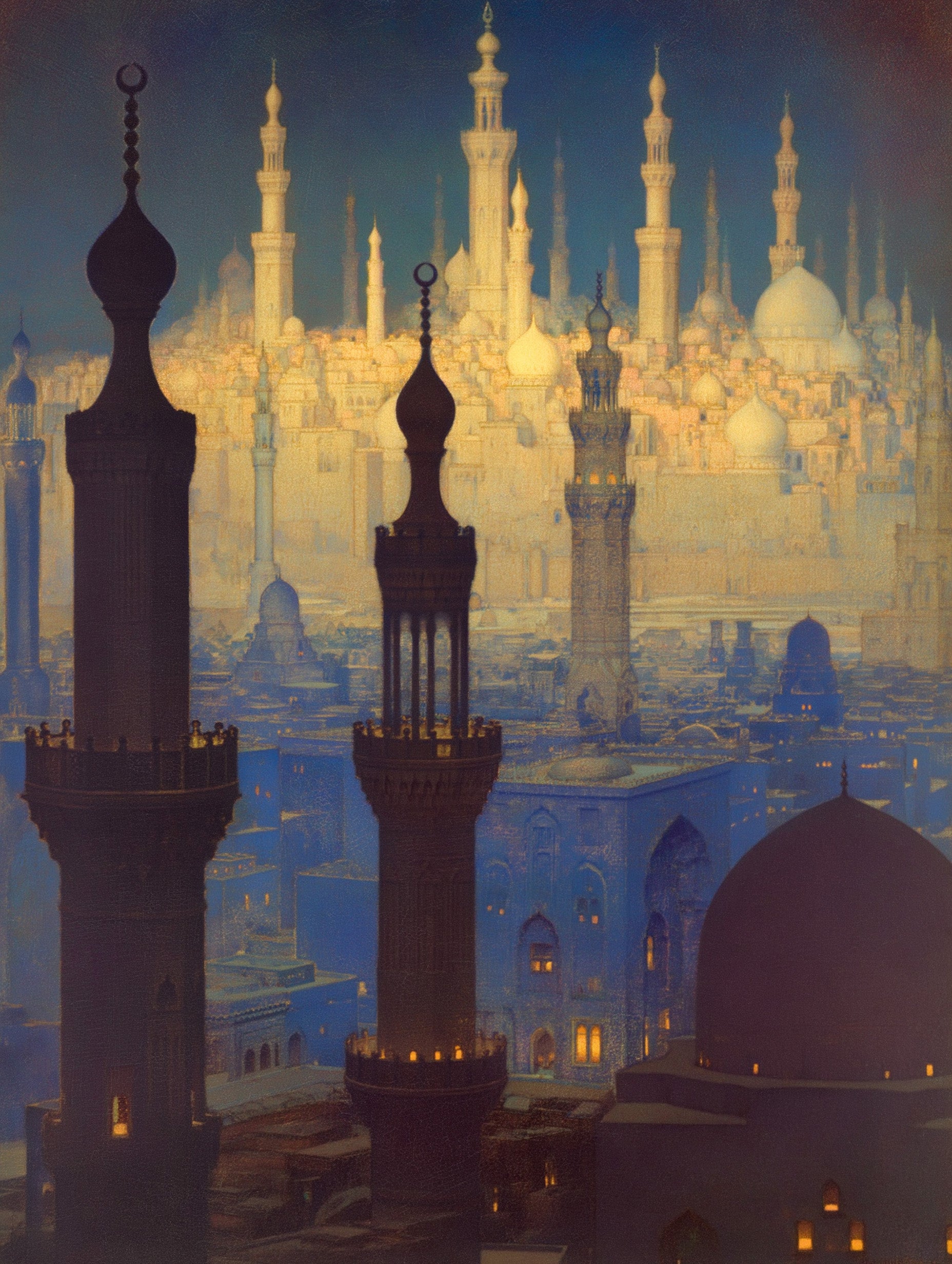
- Golden scenes for living rooms. Dusk skies, glowing domes and figures in golden silk bring warmth to a room where people gather. Scheherazade and Shahrayar or The City of a 1000 Minarets make a striking centrepiece above a sofa.
- Gardens for kitchens and dining rooms. Roses, doves, palms and still water feel fresh and light. Look at A Forgotten Gift.
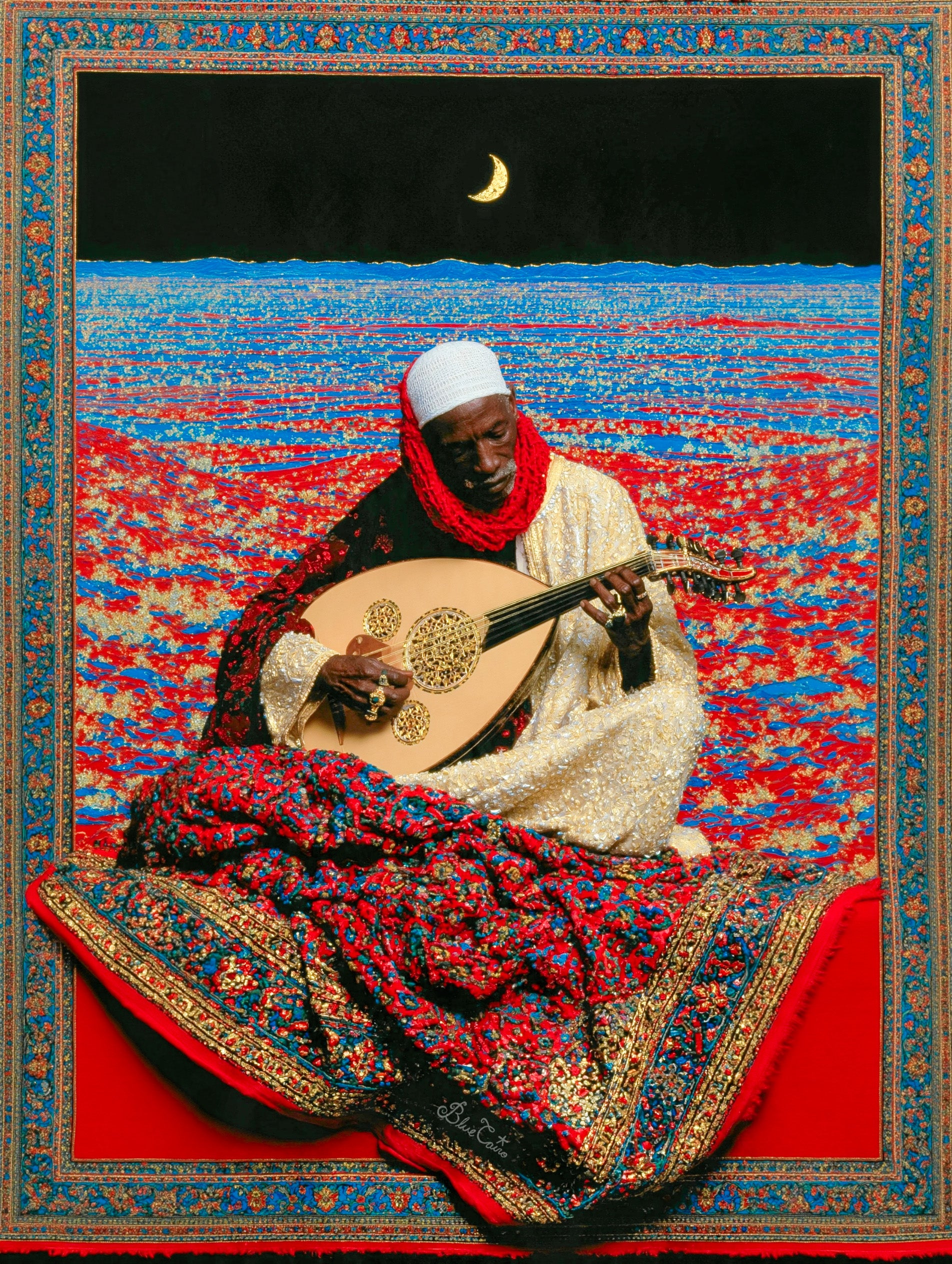
- Music and stillness for studies and reading corners. The quiet scenes of Secrets of the Night, like an old man playing the oud on a sea of carpet, invite you to slow down.
3. Build a gallery wall that tells a tale
A single print is a moment. Several prints from the same story become a chapter. Arabian Nights art is perfect for a gallery wall, because the pieces can be read in order, like the nights themselves.
- Choose three to six prints from one series, so the colours and style hold together.
- Put the strongest image at the centre, slightly larger than the others, and build outwards.
- Arrange by story or by colour. Hang them in the order of the tale, from dusk to dawn, or let the colours flow from gold on one side to blue on the other.
- Keep the gaps even. Five to eight centimetres between frames makes a group read as one piece.
- Plan on the floor first. Lay the prints out, take a photo, and cut paper templates to tape on the wall before you hammer a single nail.
4. Work with colour
The palette of the Nights is lapis blue, saffron, gold and deep red, and it is forgiving. On white or pale walls, these colours glow. On dark walls, navy, deep green or terracotta, they look like windows opening onto the night. Pick up one colour from the print in a cushion, a rug or a vase nearby, and the room will feel put together.
Arabian Nights art also loves texture. Pair it with a kilim or a carpet, a brass lantern, carved wood or a khayamiya cushion, and the scene seems to step out of the frame and into the room. Hang a lamp nearby and use warm light in the evening: these are scenes made for lamplight.
5. Hang it at the right height
- Centre at eye level. The middle of a print, or of a whole gallery wall, should sit at about 145 to 155 centimetres from the floor.
- Above furniture, leave about 20 to 25 centimetres between the top of the sofa, bed or sideboard and the bottom of the frame, so the art and the furniture read together.
- Mind the width. Above a sofa or bed, art looks best when it spans about two-thirds of the furniture’s width.
6. Pick the right finish
Our prints come in three finishes, and each suits a different home.
- Canvas is ready to hang without a frame, with a soft texture that feels like a painting. It is ideal for living rooms and bedrooms.
- Fine art paper gives sharp detail and rich colour, and looks beautiful behind glass in a simple wooden or gold frame.
- Photo Rag is a museum-quality cotton paper with a soft, velvety surface and deep, lasting colour, the choice for collectors.
Keep any print out of strong direct sunlight, and it will keep its colours for many years.
Explore the Nights
Every print in our collections was born from years of exploring Cairo’s streets, its history and its legends, and the world of the Thousand and One Nights. Begin with the 1,001 Nights collection, wander into The Blue World and Secrets of the Night, or browse all our wall art prints. And to discover how deeply the Nights are woven into the city where we work, read Cairo and the Thousand and One Nights.
The Best Photo Spots in Islamic Cairo, and the Best Hour for Each
Every photograph in our Old Cairo collection was taken on foot, over years of walking the Old City and going back, again and again, to the same corners at different hours. In Cairo the hour matters as much as the place: a minaret that looks flat and grey at noon turns gold an hour before sunset.
These are nine corners we keep going back to, and the hour each one waits for.
A note on Cairo light
Cairo’s air is often hazy. At midday the haze flattens everything, so the best hours are the first two after sunrise and the last two before sunset, when the light is low, warm and comes from the side, picking out every carved detail in the stone. At those hours the haze helps, softening the distance so the skyline falls into layers of domes and minarets.
1. The minarets of Bab Zuwayla
Best hour: late afternoon.
The southern gate of Fatimid Cairo is crowned by the two minarets of the Mosque of Sultan al-Mu’ayyad Shaykh. Climb them, and the whole Old City opens below you: a sea of rooftops and domes stretching north towards Al-Azhar. In the late afternoon the sun is behind you and lights the skyline in gold.
2. Al-Muizz Street, between Qalawun and Barquq
Best hour: the two hours before sunset.
On this stretch of Al-Muizz Street, the great Mamluk complexes of Sultan Qalawun, Al-Nasir Muhammad and Sultan Barquq stand side by side like one long wall of carved stone. In the late afternoon the low sun lights the minarets while the street below falls into shade, and the doves of the Old City circle between the towers.

3. Through the windows of Al-Muizz
Best hour: mid-morning, under a sky with clouds.
The old buildings along Al-Muizz Street are full of carved windows, wooden lattices and pointed arches. Instead of photographing a minaret directly, stand back inside a doorway or behind a window and let the carving frame it. A blue sky with white clouds makes the stone stand out.

4. The courtyard of Al-Azhar
Best hour: late afternoon.
Al-Azhar, founded in the tenth century, has minarets from many different eras, and from its white marble courtyard you can see several of them side by side. In the late afternoon they glow against the sky, and the polished marble reflects the light. Leave your shoes at the entrance and move slowly: this is a place of prayer and study.

5. Sultan Hassan and Al-Rifa’i
Best hour: early morning, or just before sunset.
The two great mosques below the Citadel face each other across a narrow street, and the street between them is a canyon: two walls of stone rising on either side of you. Inside Sultan Hassan, stand in the centre of the courtyard and turn slowly. Each of the four vast vaulted halls, the iwans, opens towards you. Read our guide to the two mosques for their story.
6. The terrace of the Citadel
Best hour: sunset.
From the terrace beside the Mosque of Muhammad Ali, the whole city lies at your feet. Look down on the domes and minarets of Sultan Hassan and Al-Rifa’i, and on a clear day you can see all the way to the Pyramids on the edge of the desert. Check the closing time before you go, so you are still inside when the sun goes down.

7. Al-Maridani Mosque
Best hour: sunset, from the street outside.
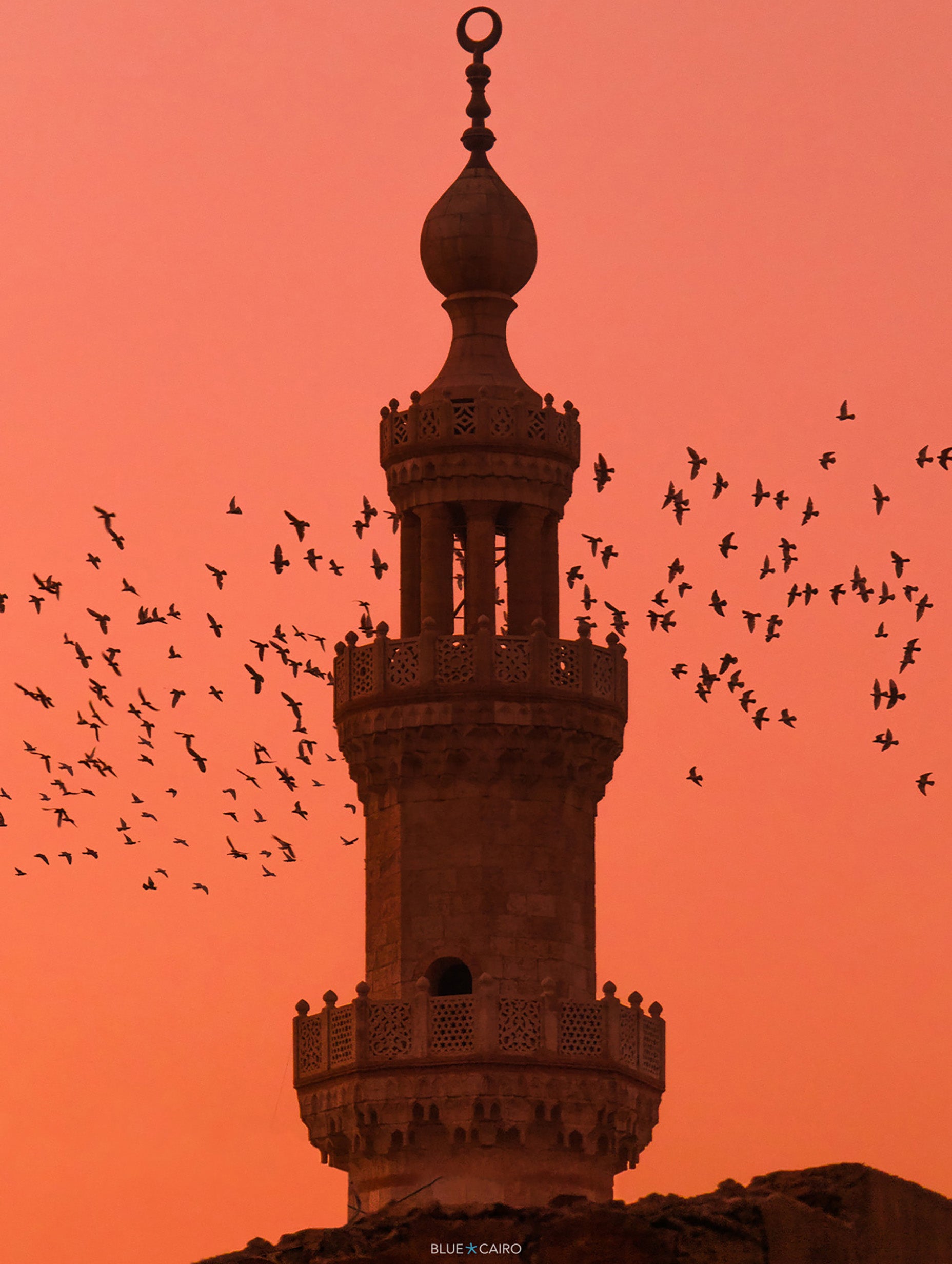
Built in 1340 on the road from Bab Zuwayla to the Citadel, the Mosque of Al-Tinbugha al-Maridani has a quiet courtyard shaded by trees, and one of the most elegant minarets of the Mamluk age. At sunset, step back into the street and wait for the birds: flocks of them sweep past the minaret against the coral sky.
8. The Mosque of Ibn Tulun
Best hour: early morning.
Built in the ninth century, Ibn Tulun is the oldest mosque in Cairo that survives in its original form, and it is vast and calm. Photograph the long rows of pointed arches around the courtyard as the morning sun throws their shadows across the ground. Then climb the spiral staircase of its unusual minaret for a view over the rooftops towards the Citadel.
9. Inside: ceilings, lamps and carved wood
Best hour: whenever the sun reaches inside.
Some of the most beautiful photographs in Old Cairo are taken looking up. The mosques and madrasas of the Old City hide gilded wooden ceilings, great chandeliers, bronze lamps hanging on long chains and carved wooden panels of stars and polygons. Look for the moment when a shaft of sunlight enters through a window and falls across the carving.

Etiquette and practical tips
- Dress for the mosques. Cover shoulders and knees. Women should carry a scarf to cover their hair. Shoes come off at the door.
- Avoid prayer times. Visitors are asked to wait outside during prayers, and especially during the Friday midday prayer.
- Ask before photographing people. A smile and a gesture towards your camera is usually enough, and most people will say yes.
- Leave the drone at home. Flying drones in Egypt requires official permission, and they may be confiscated at the airport.
- Tripods and professional cameras may need a separate ticket or permit at some sites. A phone or a small camera is welcome almost everywhere.
- Keep small notes for the guardians who unlock minarets and roofs. A small tip often opens a door that would otherwise stay closed.
Our Cairo Guide marks the exact spots and angles for the best photos at every place on its four routes, so you know where to stand before you arrive. And every photograph in this article can hang on your wall: explore all our Old Cairo photography prints.
Sultan Hassan and Al-Rifa’i: Visiting Cairo’s Two Great Mosques
Below the walls of the Citadel, two giants stand face to face. On one side of the street is the Mosque-Madrasa of Sultan Hassan, built in the fourteenth century and one of the greatest buildings of medieval Islam. On the other is the Al-Rifa’i Mosque, finished in 1912 and built to match it, stone for stone, in grandeur. They were built five and a half centuries apart, yet from the Citadel above they look like one building, and their domes and minarets are the skyline most people picture when they think of Old Cairo.

Sultan Hassan: the mountain of stone
Sultan al-Nasir Hasan came to the throne of Mamluk Egypt as a boy, and his reign was a restless one. He was deposed, returned to power, and in 1361 was overthrown again and killed. His body was never found.
In 1356 he began the most ambitious building Cairo had ever seen. It was paid for in part, the chronicles say, by the wealth left behind by the victims of the Black Death, which had swept through Egypt a few years before. The building was so vast that work went on for years after the Sultan’s death, and parts of it were never finished. Look closely at the great entrance portal: some of its carvings stop halfway, the outlines drawn on the stone but never cut.
The building was a mosque and also a madrasa, a college for the four schools of Sunni law. Its plan is simple and overwhelming. You pass through the tall portal and a dark, winding corridor, and then the space opens suddenly into a great open courtyard with a domed fountain at its centre. On each of its four sides an immense vaulted hall, an iwan, opens towards you, one for each school of law. Behind each iwan, hidden in the corners of the building, were the rooms where students lived and studied.
Walk into the iwan that faces Mecca, the largest of the four. Its walls are lined with coloured marble, and a band of great stucco inscriptions runs around it high above your head. Behind the wall of this iwan is the domed mausoleum where the Sultan was meant to be buried.
The building’s size made it dangerous. In 1361, one of its minarets collapsed and killed many people in the street below. Its height and position, so close to the Citadel, also made it a fortress: in the troubled years of the Mamluk state, rebels more than once climbed its roof to fire on the Citadel, and the sultans had its stairs blocked to stop them.

Al-Rifa’i: the royal twin
In 1869, Khushyar Hanim, the mother of Khedive Ismail, decided to build a mosque on the site of an old shrine of a local saint of the Rifa’i Sufi order, directly across from Sultan Hassan. She wanted it to be worthy of its neighbour, and to serve as a mausoleum for herself and her descendants, the royal family of Egypt.
Work stopped for many years, and the mosque was only completed in 1912, under the Austro-Hungarian architect Max Herz, who also worked to preserve the medieval monuments of Cairo. The result looks back to the Mamluk age, with its domes, minarets and carved stone, but it is richer and more ornate: gilded ceilings, marble columns, carved wood and inlay in every corner.
Al-Rifa’i is a royal necropolis. Here lie Khushyar Hanim herself, Khedive Ismail, King Fuad I and King Farouk, the last king of Egypt. And in a quiet room of green marble lies a guest from far away: Mohammad Reza Pahlavi, the last Shah of Iran, who died in exile in Cairo in 1980.

What to look for
- The portal of Sultan Hassan. Stand at the bottom and look up. Its great carved hood of stone honeycomb, the muqarnas, is one of the tallest of its kind in the Islamic world.
- The courtyard. Stand by the fountain and turn slowly to see all four iwans in turn.
- The lamp chains. In the qibla iwan, long chains hang from the vault. They once held the enamelled glass lamps that lit the hall; the originals are now in museums.
- The mausoleum dome. Look up into it from inside, and listen: it is famous for its echo.
- The royal tombs of Al-Rifa’i. Walk through the side halls to find the tombs of the khedives and kings, and the room of the Shah.
- The street between them. Stand in the middle of the narrow street that separates the two mosques and look up. The walls on either side rise like the sides of a canyon.
Practical tips for your visit
- Tickets. Both mosques are managed by the Ministry of Tourism and Antiquities, and one ticket has usually covered both. Check the current price before you go.
- Dress. Cover shoulders and knees. Women should cover their hair; scarves are sometimes available at the entrance. Shoes come off before you enter the prayer halls.
- Prayer times. Visits pause during prayers. Avoid Friday around midday entirely.
- Light. Come in the morning, when the courtyard of Sultan Hassan is lit softly, or in the late afternoon, when the domes glow from the Citadel above.
- Combine. The Citadel is right above the two mosques, and the Mosque of Ibn Tulun and the Mosque of Al-Maridani are both a short taxi ride or a long walk away.
- Guardians. Keep small notes. A guardian may offer to open a closed door, show you a tomb or point out the echo in the dome, and a small tip is customary.
Our Cairo Guide leads you to these two mosques on its route through the medieval city, with timings, a Google Maps link, ticket prices and the best spots for photos. For more of the Old City, read our best photo spots in Islamic Cairo and how to read the minarets of Cairo.
Cairo and the Thousand and One Nights
Kan ya ma kan: once upon a time. For centuries Arabic storytellers have opened their tales this way, and no tales are more famous than the Thousand and One Nights, the collection known in English as the Arabian Nights.
The frame: Shahrazad and Shahrayar
The story begins with two kings, the brothers Shahrayar and Shahzaman. Betrayed and broken, Shahrayar decides to marry a new bride every night and put her to death at dawn. The city empties, until Shahrazad, the vizier’s daughter, who has read every book of history, poetry and legend, offers herself. On her wedding night she begins a tale and stops at dawn before the ending. The king lets her live one more day to hear the rest, and so it goes on for a thousand and one nights.
Image: Blue Cairo
From Baghdad to Cairo
The oldest layer of the stories came from Persia and India and was told in Arabic in Abbasid Baghdad. But the collection kept growing for centuries, and storytellers in Mamluk and Ottoman Cairo added many tales of their own, often set in their own city, among its merchants, its markets and the Nile. Much of the Nights as we read it today passed through Cairo.
It was also in Cairo that the Nights was first printed in Arabic, at the Bulaq press in 1835. That edition became the basis of many later translations, including the French version by Joseph-Charles Mardrus, which Powys Mathers later turned into English as The Book of the Thousand Nights and One Night.
The storyteller of the coffeehouse
For centuries these tales were also performed aloud. The hakawati, the storyteller of the coffeehouse, would recite them night after night, stopping, like Shahrazad, at the most exciting moment so that his audience would come back the next evening.
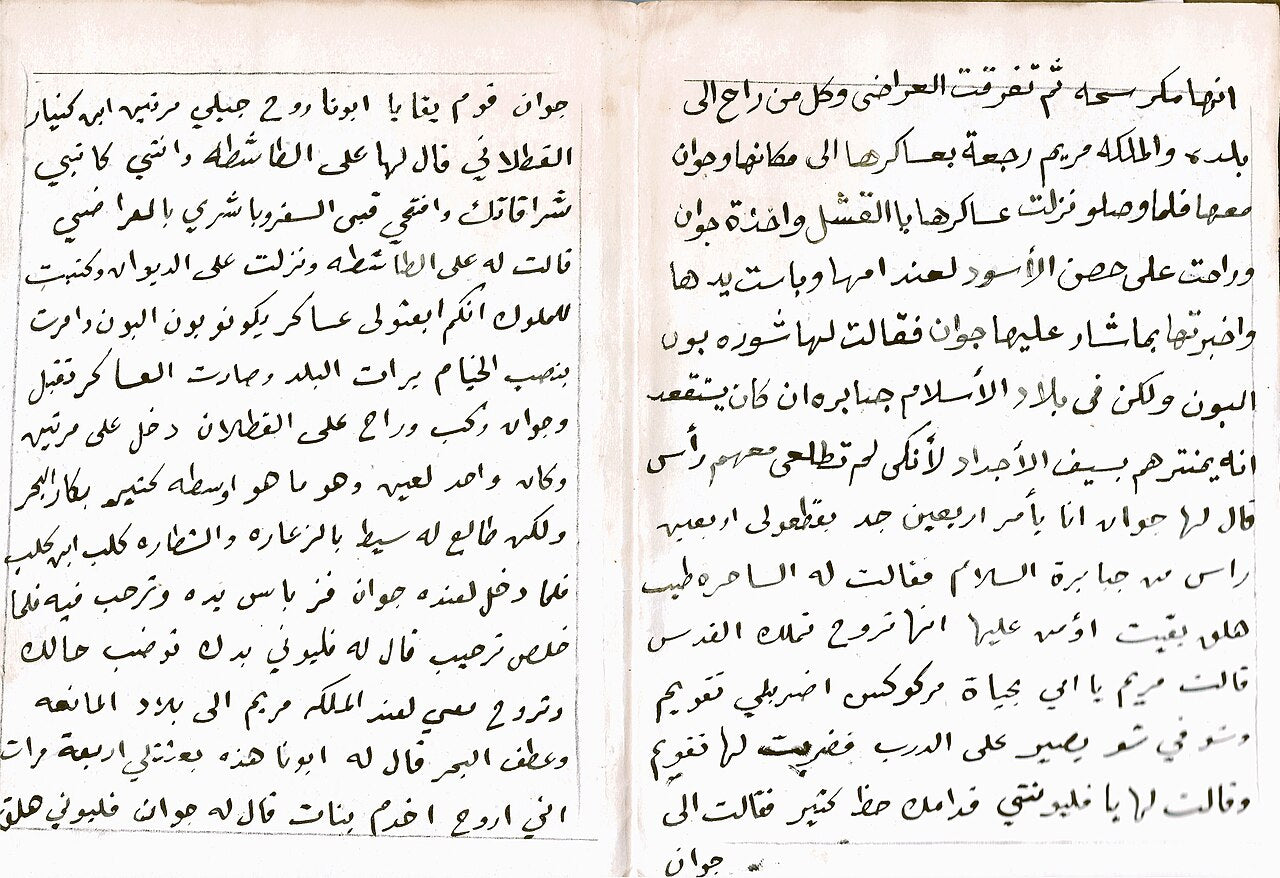
Image: Wikimedia Commons, public domain
Painting the Nights
Our 1,001 Nights collection follows the frame story scene by scene: Shahrayar’s Sorrow, 1000 Dawns Without Mercy, Before the First Tale and Scheherazade and Shahrayar, through to The Jinn of the Sea. Each print comes on canvas, fine art paper or Photo Rag, and each one is a scene from those thousand and one nights.
How to Read the Minarets of Cairo
Cairo has been called the City of a Thousand Minarets for centuries. From any rooftop in the old city you can see dozens of them, and once you know what to look for, the skyline becomes a history book. Each era built its towers differently.
The spiral of Ibn Tulun
The oldest minaret people usually see is at the Mosque of Ibn Tulun (876–879). Its outer staircase winds around the tower and recalls the great spiral minaret of Samarra in Iraq, where Ibn Tulun grew up. You can climb it, and from the top the whole of Old Cairo lies in front of you. (We painted Samarra’s own spiral in Samarra’s Spiral Minaret.)
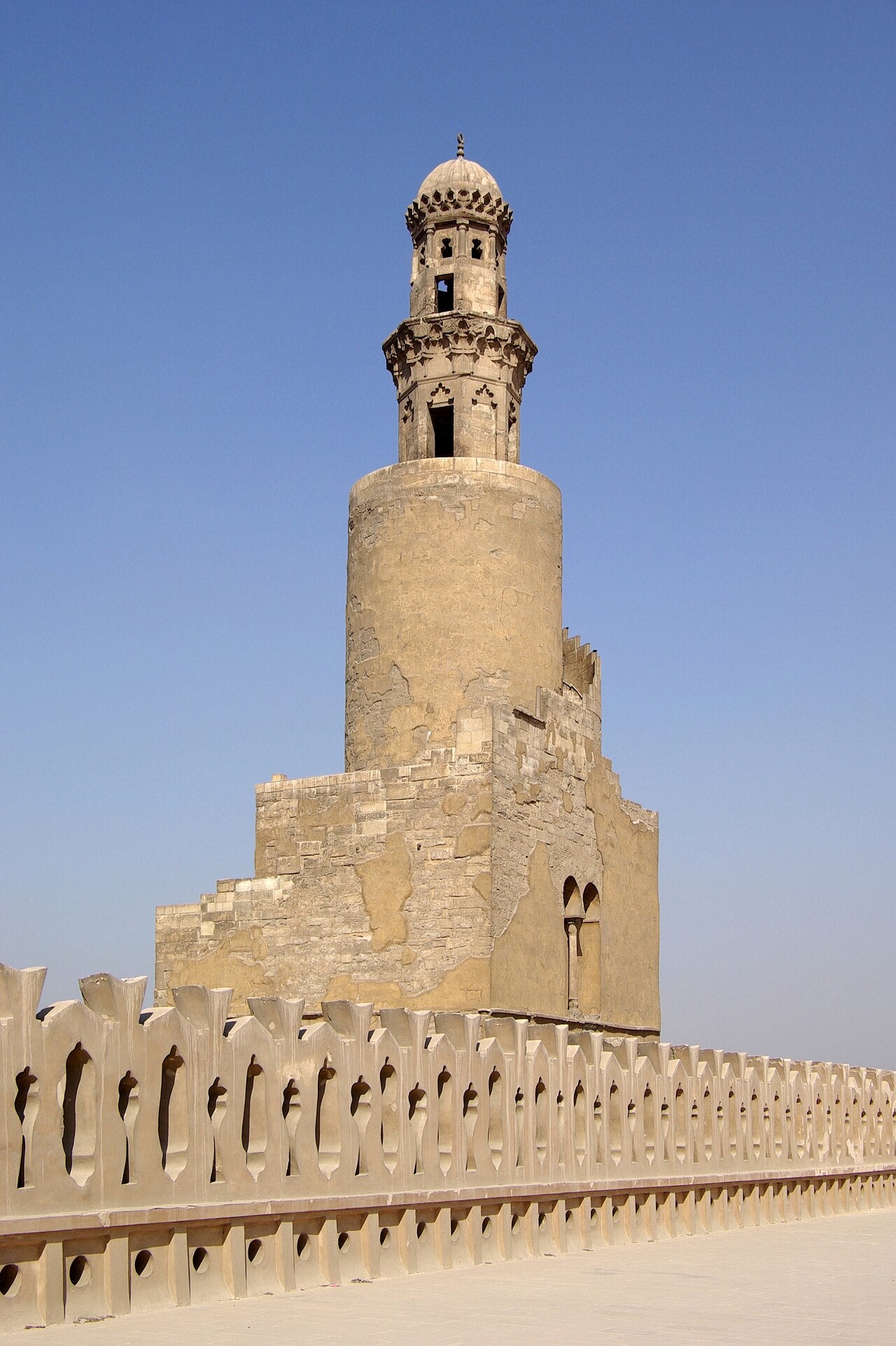
Photo: Berthold Werner, CC BY 3.0, via Wikimedia Commons

The Mamluk minaret: three storeys and a crown
Most of the minarets on the skyline are Mamluk, built between the thirteenth and early sixteenth centuries. Read them from the bottom up: a square base, then an octagonal middle storey, then a slender round top with a small pavilion and a bulb-shaped finial. Between the storeys runs a carved balcony on stalactite-like brackets called muqarnas, where the muezzin once stood to call the prayer.
Look for the minaret of Al-Maridani Mosque (1340) rising over Bab al-Wazir, the pair of towers at the mosques of Sultan Hassan and Al-Rifa’i beneath the Citadel, and the forest of minarets around Al-Azhar, including the double-headed minaret of Sultan al-Ghuri. Sultan Hassan’s mosque-madrasa (1356–1363) and Al-Rifa’i (completed 1912) stand side by side, so in one view you see the Mamluk original and its modern echo.
Image: Blue Cairo
Image: Blue Cairo
The Ottoman pencil
After the Ottomans arrived in 1517, a new shape appeared: tall, thin, round minarets ending in a sharp cone, like a pencil. The most famous are the twin minarets of the Mosque of Muhammad Ali on the Citadel (1830–1848), visible from almost everywhere in the city.
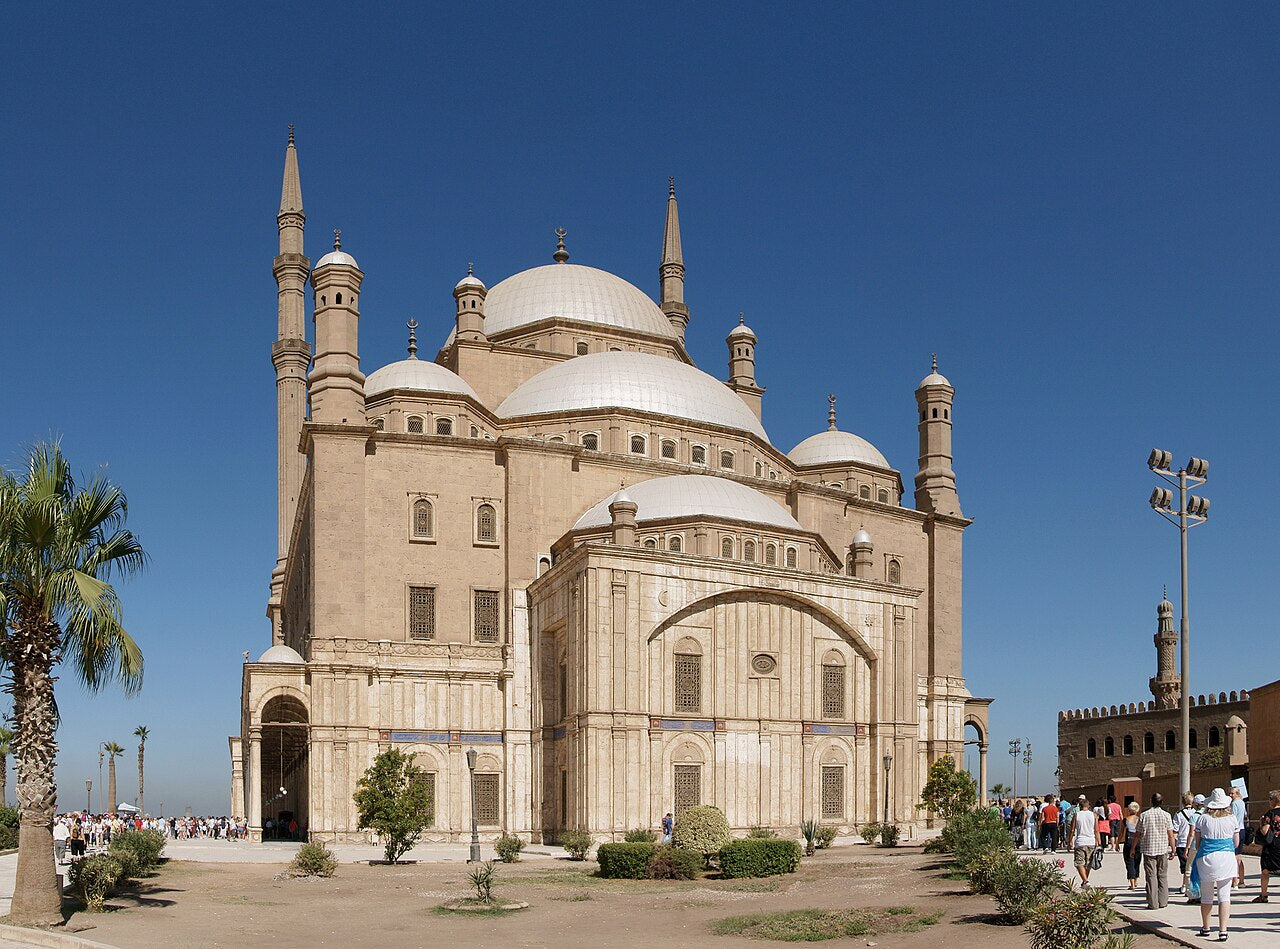
Photo: kallerna, CC BY-SA 3.0, via Wikimedia Commons

Where to see them best
- At sunrise or sunset from a rooftop café near Al-Azhar or the Citadel.
- From the top of the minarets of Bab Zuwayla, at the end of Al-Muizz Street.
- From Al-Azhar Park, where the whole Mamluk skyline is lined up against the sky.

Photo: Błażej Pindor, CC BY 3.0, via Wikimedia Commons

We have spent years photographing these towers at every hour. See them in Sunrise over Old Cairo, The Wings of Cairo II and The Illuminated One, part of our Old Cairo photography prints, or dreamt in blue in The Blue World.
A Walk Down Al-Muizz Street, the Heart of Old Cairo
If you only have one morning in Old Cairo, spend it on Al-Muizz Street. It is about a kilometre long, and it holds more medieval Islamic architecture than almost any other street in the world. The street carries the name of the Fatimid caliph al-Mu’izz li-Din Allah, under whom Cairo was founded in 969, and it was the main avenue of the walled city for centuries.
1. Start in the north, at Bab al-Futuh
Begin at the northern gate, Bab al-Futuh, built by the Fatimids in the eleventh century. Walk south with the walls behind you. The street narrows, the noise of the city drops, and the first minarets appear above the shops.

Photo: Djehouty, CC BY-SA 4.0, via Wikimedia Commons

2. Al-Aqmar and Bayt al-Suhaymi
Look for the small Al-Aqmar Mosque (1125), one of the few Fatimid buildings that survive almost whole. Its carved stone façade is full of shells, inscriptions and star shapes. A few steps away, in the side lane of Darb al-Asfar, is Bayt al-Suhaymi, a seventeenth-century Ottoman house of courtyards, fountains and carved wooden mashrabiya windows.

Photo: R Prazeres, CC BY-SA 4.0, via Wikimedia Commons


Photo: Saeed Mohammed zaman, CC0, via Wikimedia Commons

3. The Mamluk stretch
Further south the street opens onto the great Mamluk foundations: the complex of Sultan Qalawun (1284–1285), with its hospital, mausoleum and madrasa, and next to it the madrasa of Sultan Barquq from the late fourteenth century. Step inside Qalawun’s mausoleum if it is open: the light through the coloured windows falls on carved stucco and marble inlay, and it is one of the most beautiful rooms in Cairo.
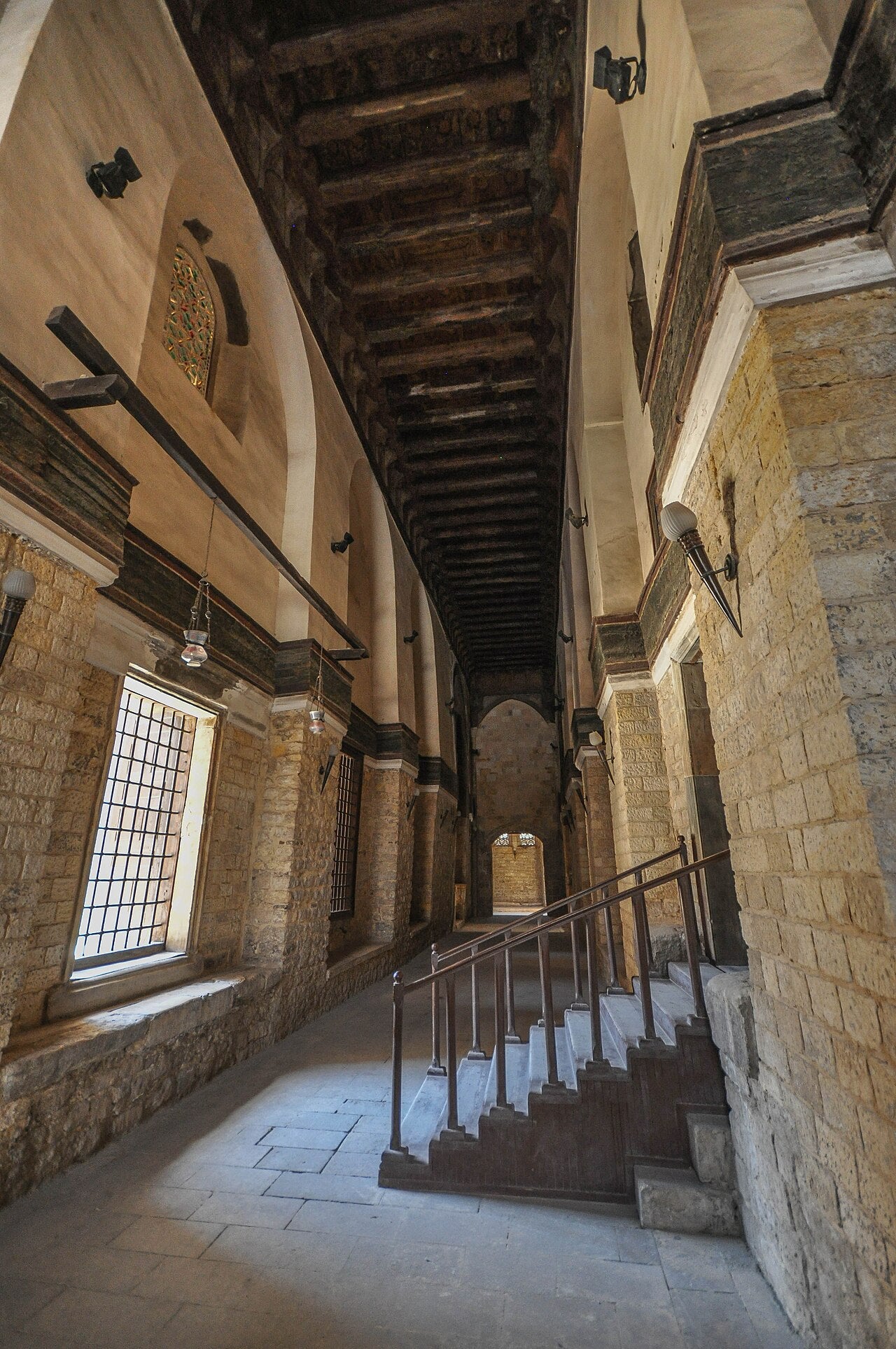
Photo: Jorge Láscar, CC BY 2.0, via Wikimedia Commons

4. The Sabil-Kuttab of Katkhuda
Stop at the Sabil-Kuttab of Abd al-Rahman Katkhuda (1744), where the street forks. The ground floor gave free water to passers-by and the upper floor was a school for children. Its wooden balcony is one of the most photographed corners of the city.

Photo: Berthold Werner, CC BY 3.0, via Wikimedia Commons

5. End at Bab Zuwayla
Cross the busy Al-Azhar Street, pass the textile and spice sellers, and finish at Bab Zuwayla, the southern gate. Its two minarets belong to the Mosque of Sultan al-Mu’ayyad Shaykh (1415–1420). Climb them for the best view over the rooftops, domes and minarets of the Old City.
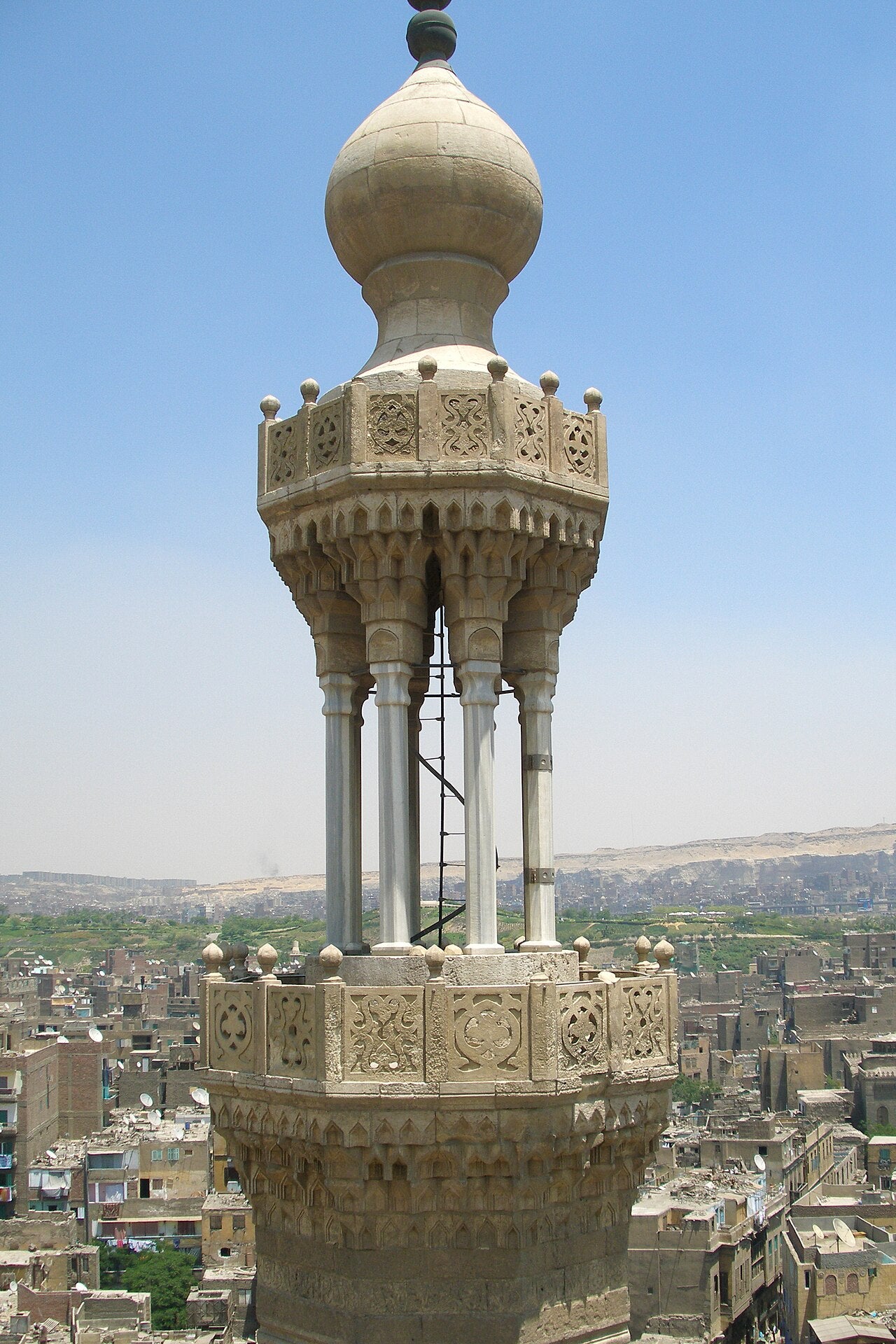
Photo: Vyacheslav Argenberg, CC BY 4.0, via Wikimedia Commons

Tips
- Go early in the morning or in the late afternoon, when the light is warm and the stone glows.
- Khan el-Khalili is next to the street, so lunch and shopping are close by.
- Dress modestly to enter the mosques, and keep small notes for the guardians who open locked doors.
Our Cairo Guide has this walk as a full route with timings, a Google Maps link, ticket prices and the best spots for photos. And if you fall in love with the minarets of Al-Muizz, they are on our walls too: see The Wings of Cairo and the rest of our Old Cairo photography prints.