
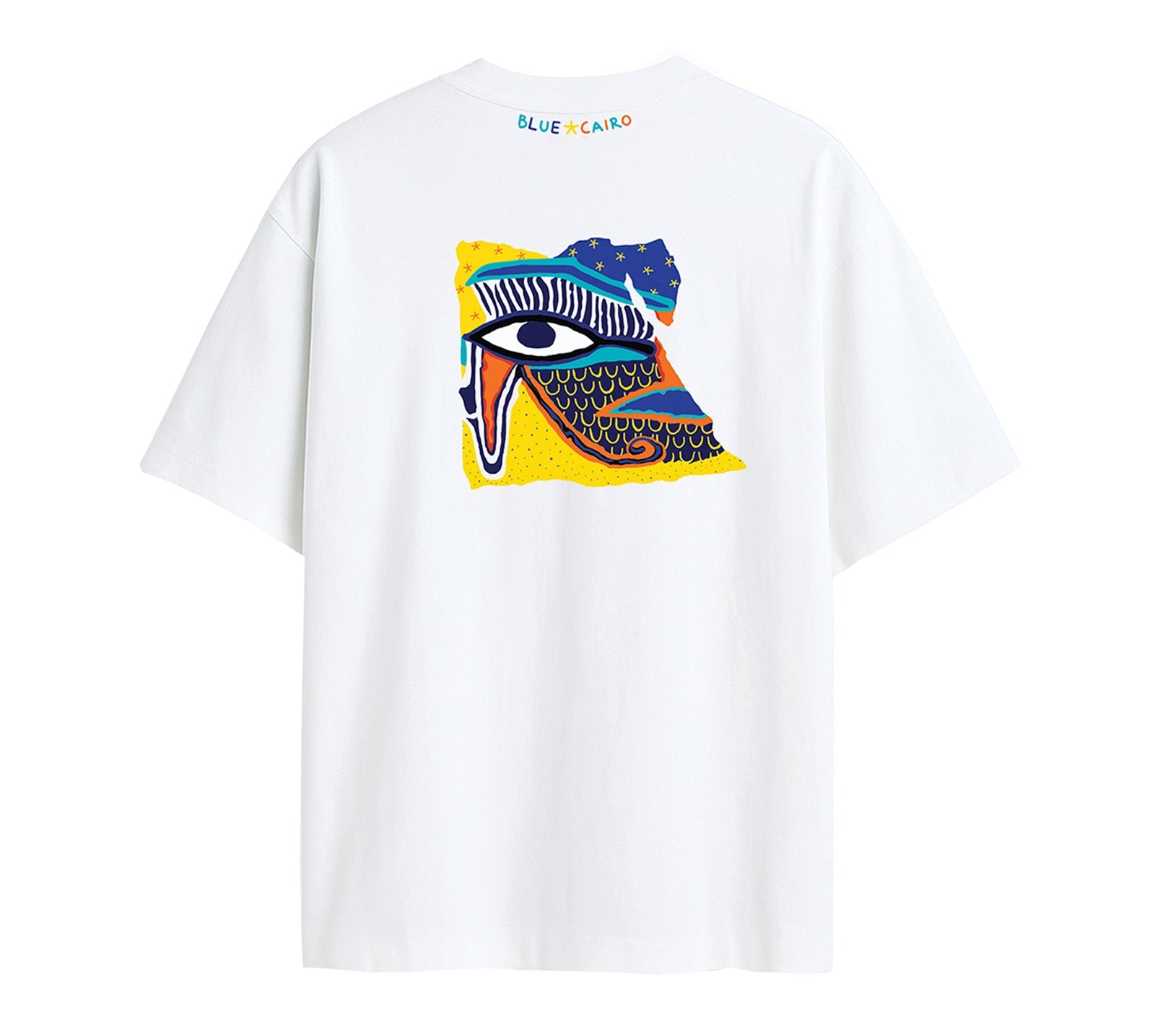
A god's lost eye, a battle for the throne of Egypt, and the most popular amulet of the ancient world. What the Eye of Horus means, and why Egyptians still wear it.
It is one of the most recognisable symbols in the world: a single eye, outlined in dark paint, with a line sweeping back from its corner, and beneath it a teardrop and a long curling tail. You will find it on ancient coffins and royal jewellery, in the hieroglyphs on temple walls, on tattoos and necklaces, and today on the walls of souvenir shops all over Egypt. It is the Eye of Horus, and behind it is the story of a stolen throne and an eye that was broken and healed.
The myth: a battle for the throne
In the beginning of the story, the god Osiris rules Egypt as a wise and good king. His brother Set, god of the desert, storms and chaos, is consumed by jealousy. Set murders Osiris and takes his throne.
Osiris's wife, the goddess Isis, searches the land for her husband's body. With her magic she brings him back to life long enough to conceive a son, Horus, whom she hides and raises in secret in the marshes of the Nile Delta. When Horus grows up, he sets out to avenge his father and claim the throne that is rightfully his.
The struggle between Horus and Set is long and brutal. In one of their battles, Set tears out Horus's eye and breaks it into pieces. But the eye is found and made whole again. In most versions of the myth it is Thoth, the wise god of writing and magic, who restores it; in another, the goddess Hathor heals it with gazelle's milk.
Horus does not keep the healed eye. He offers it to his dead father, Osiris, and through this gift Osiris is revived to rule over the afterlife. Horus wins the throne of the living and becomes the protector of the kings of Egypt, every one of whom was seen as Horus on earth.
What the Eye of Horus means
The Egyptians called it the wedjat, which means "the sound one" or "the whole one". It is the eye that was broken and made whole again, and so it stands for everything that the myth tells: protection, healing, restoration and the triumph of order over chaos.
Horus was a falcon god, and the eye is a falcon's eye as much as a human one. Look at the face of a peregrine falcon and you will see the same dark marking sweeping down beneath its eye, the origin of the teardrop and tail of the symbol.
The Eye of Horus and the Eye of Ra
The two are often confused, and the ancient Egyptians themselves sometimes blurred them. As a general rule, the Eye of Ra is linked to the Sun and to the fierce power of the Sun god, often shown as a goddess who can protect or destroy. The Eye of Horus is linked to the Moon, which wanes and is made whole again each month, just as the eye was broken and healed. You will often read that the Eye of Ra is the right eye and the Eye of Horus is the left, a useful way to remember the difference.
The mathematical eye
You may also read that each part of the eye stood for a fraction (one half, one quarter, one eighth, and so on down to one sixty-fourth), and that the missing sixty-fourth was the piece Thoth restored by magic. It is a popular idea, though many Egyptologists today doubt the connection.
The most popular amulet in Egypt
For thousands of years, Egyptians wore the wedjat to keep harm away. It was made in faience, glass, gold, silver, carnelian and lapis lazuli, worn on necklaces and bracelets by the living, and placed among the wrappings of the dead to protect them on their journey to the afterlife. It is one of the most common amulets found in ancient Egyptian tombs.
Tutankhamun was buried with jewellery bearing the wedjat, and you can see some of it among his treasures in the Grand Egyptian Museum. On many coffins of the Middle Kingdom, a pair of eyes was painted on the side of the coffin, where the face of the dead lay, so that they could look out at the world of the living and the rising Sun.
The eye also appears in hieroglyphs, on temple walls and on stelae, and painters and sailors are said to have painted eyes on the prows of boats so that they could see their way and avoid danger, a custom you can still find on fishing boats around the Mediterranean.

The eye in Egypt today
The ancient gods are long gone, but the eye never left Egypt. It lives on in a different form in the blue glass eye beads sold in every market, pinned to babies' clothes, hung in cars and over shop doors to turn away envy. It stares out from the backs of the painted trucks on Egypt's highways, as we explain in our story of Egyptian truck art. And it is still worn, as a pendant or a tattoo, by people all over the world who want to carry a little protection with them.
The belief behind it has hardly changed in five thousand years: that a watchful eye, painted with care, can turn away harm and bring what is broken back to wholeness.
Wearing the eye
We painted our own Eye of Horus in bold blue, orange and yellow, beneath a corner of starry night sky, and printed it on the back of a white oversized T-shirt. It is part of The Season of the River, our summer collection of Egypt's oldest stories, alongside Ra's night journey in hieroglyphs, the golden women of an ancient wall painting, and a cat keeping watch over Cairo.
See the Eye of Horus T-shirt and the rest of our Egyptian art apparel. And if you are travelling to Egypt to meet the eye in its homeland, our Cairo Guide will help you plan the trip.